


Early Harvesting and Maximizing the Performance of Your Post-Harvest Herbicide

2026-09-22
In the event of an early harvest, there may be an excellent opportunity to use a post-harvest herbicide application to manage hard-to-control winter annual and perennial weeds and help clean up fields for the following growing season.
The effectiveness of a post-harvest application depends on weed growth, environmental conditions, application timing and giving the herbicide enough time to move throughout the plant.

Tips to help achieve great post-harvest weed control:
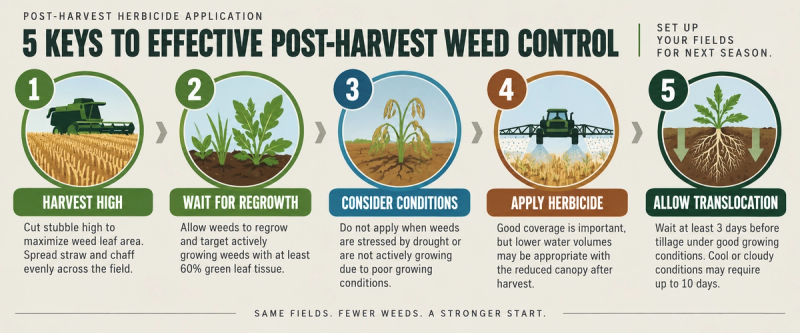
Harvest management:
Consider cutting stubble high to maximize weed leaf area and to minimize the time it will take for plants to grow to the recommended stage. Also ensure straw and chaff are spread evenly so that proper coverage is obtained on low-growing and smaller weeds.
Ensure adequate regrowth:
After harvest, spraying should be delayed until weeds grow back and develop new leaves. For effective control, any weed that is being sprayed post-harvest should be actively growing and have a minimum of 60% green leaf tissue. Avoid herbicide application if growing conditions are poor due to drought or other stress factors.
Tillage interval:
Under good growing conditions, allow a minimum of 3 days after application before tillage for the herbicide to translocate in the plant as much as possible. Under cool and cloudy conditions plant growth may slow down, so it is recommended to allow more time for translocation of the product to the roots of the weed (up to 10 days).
Water volume:
Since there is minimal canopy covering the target weeds, lower water volumes may be used.
Tank mixing for winter annual weed control:
Perennial weeds are at low risk to develop glyphosate resistance, therefore applying glyphosate alone at post-harvest can be an economical and effective way to control perennial weeds. When targeting heavy populations of winter annuals or late flushing annual weeds that may reach seed-set, consider adding a tank-mix partner like BATTLEFRONT® or MPOWER® EXTRA HERBICIDE. When selecting a tank-mix partner, verify the product’s label for any re-cropping restrictions.
Spraying After A Frost
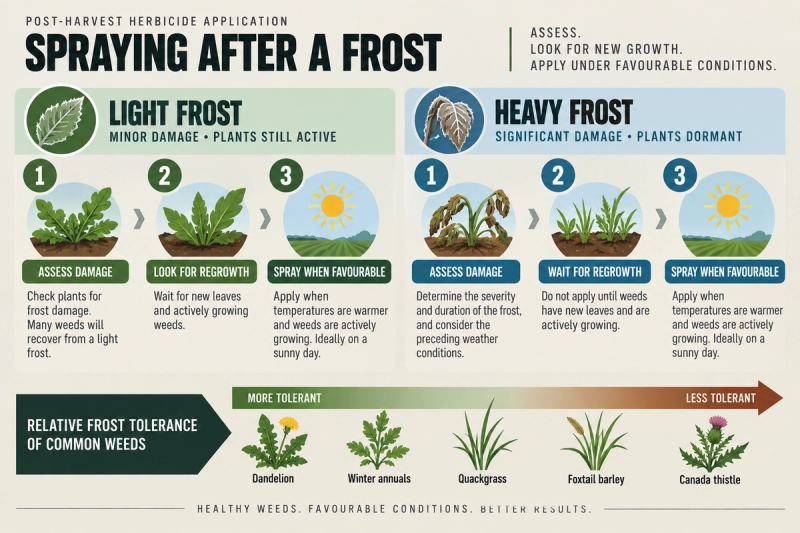
The impact of frost on weed control depends on the length and severity of the freezing temperatures, preceding weather, and the weed species. Generally, from most frost tolerant to least frost tolerant are dandelions, winter annuals, quackgrass, foxtail barley and Canada thistle. When possible, spray late in the morning or early afternoon when it’s warm and plants are most actively growing. Ideally, spray on sunny days. With cool temperatures, stop spraying 2 hours before sunset
Your Question Answered
Should You Add A Tank Mix Partner To Your Post-Harvest Glyphosate?
Yes. Adding a tank mix partner such as BATTLEFRONT® or MPOWER® EXTRA will improve control of tough to kill weeds such as dandelion, flixweed, narrow-leaved hawk’s-beard, stinkweed, volunteer canola, and more. Plus it will get your cereal crops off to a cleaner start next year.
Your Question Answered
What About Spraying Perennial Weeds After Harvest?
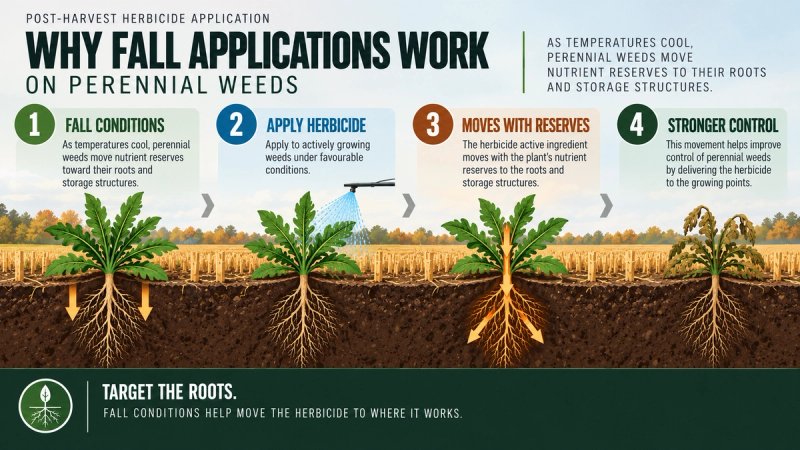
Cooler temperatures in the fall trigger the movement of nutrient reserves down to the root or storage structures of perennial plants to build up reserves for growth in the following season. A fall herbicide application takes advantage of this increased nutrient flow to the roots, increasing the amount of active ingredient that reaches the plants growing points.
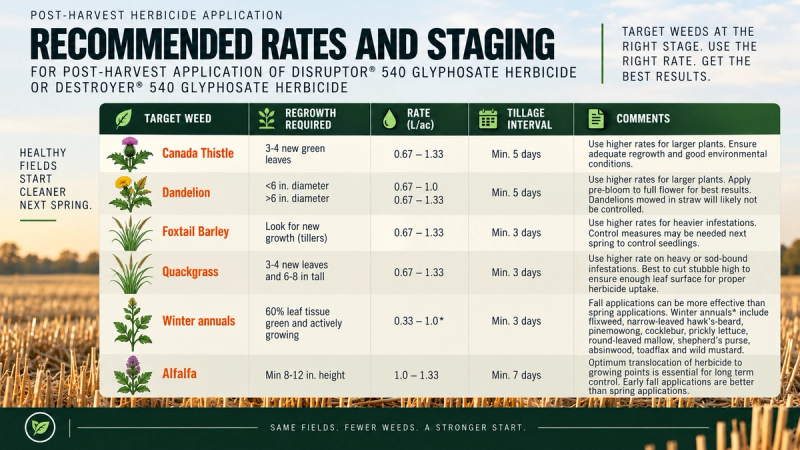
Recommended Rates and Staging for Post-Harvest Application of Glyphosate
The following are application and staging recommendations based on the weeds being targeted for a post-harvest application of DISRUPTOR® 540 GLYPHOSATE HERBICIDE or DESTROYER® 540 GLYPHOSATE HERBICIDE:
*Control of winter annuals will be improved with the addition of a pre-seed broadleaf herbicide such as BATTLEFRONT® HERBICIDE or MPOWER® EXTRA HERBICIDE.
Summary
A post-harvest herbicide application is a great strategy for cost-effective, long-term perennial and winter annual weed control. So, when the window for pre-harvest application has passed, and winter annual and perennial weeds are in your fields, consider a post-harvest application for a head start in the spring.
Talk with your 1909 Representative
1909 has competitive prices on a complete line of fungicides, herbicides, inoculants, micronutrients, foliars and desiccants. Talk to your local 1909 business representative, go to 1909.ufa.com or call 1-844-269-3276 to discuss how 1909 can help manage your input costs.
BATTLEFRONT®, DESTROYER™, DISRUPTOR® and MPOWER® are trademarks of 1909 or its affiliates.