

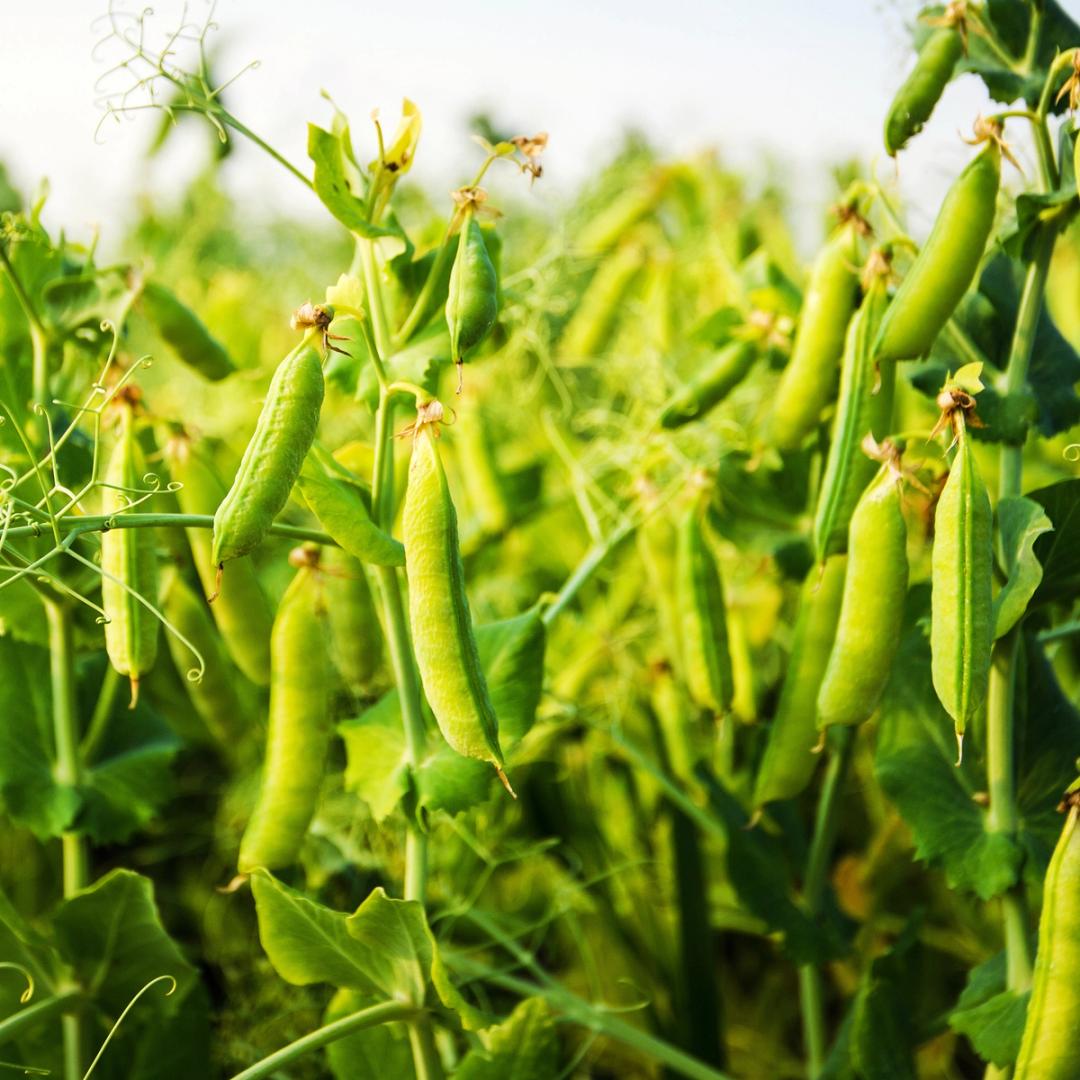
Ideas To Manage Pulse Crop Inputs

2026-09-03
While farming has changed in the past few years, the need to control input costs has not. And with input costs on the rise, how can you manage your input costs for pulse crops in 2026? Below are some ideas that can help.

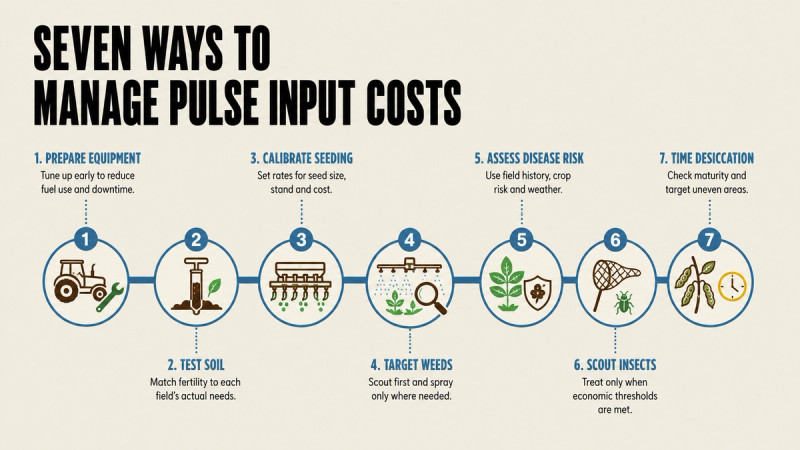
1. Make Sure Your Equipment Is Field Ready
- Tune up and repair all your field equipment prior to spring work.
- Poorly maintained equipment can increase fuel consumption and operating costs, plus increase the chances of breakdowns in season.
2. Review Your Fertility Requirements
- Start with a soil test. Fertilizer is one of the biggest expenditures on your farm, so soil testing makes a lot of sense. Following updated soil test recommendations can help pinpoint precisely what each field needs.
- Do you need the same fertility inputs on every field every year? Are some fields higher in available nutrients due to dry conditions or crop rotations? Check field-specific soil tests to make sure.
- Is variable rate application right for your farm? Varying the rate of fertilizer (or other inputs) across a field could help reduce your total fertilizer costs without losing yield.
3. Calibrate Seeding Rates And Equipment
- Check seeding rates. A lower than recommended seeding rate will reduce your plant stand, decrease competition with weeds and even reduce yield. A higher than recommended seeding rate will increase your cost/acre.
- Always check the seed size and calibrate your seeding equipment accordingly before you start seeding.
4. Evaluate Your Herbicide Needs
- Start by reviewing last year. What weed problems were noticeable at harvest? This can help you determine what weeds are likely to be a problem this year.
- What is the right product for each field? Different fields can have different weed issues, make sure you scout fields thoroughly prior to application to determine the best product for each field.
- Pre-seed - plan on a pre-seed application to manage hard to kill weeds, as there are limited in-crop options for weeds such as kochia.
- Or consider an application of Gowan’s Edge® pre-emergent prior to seeding as well as pre-seed.
- Do you need to spray the whole field? Shutting off the sprayer in weed free areas of the field could reduce your herbicide costs without compromising weed control.
- Could faster sprayer fills save time and money? Consider a bigger pump or water hauling system. Filling the sprayer takes a lot of time, faster filling can free up more hours for application, especially if weather conditions are less than ideal for application.
- Save money on herbicides by buying your pulse crop products from 1909, many of which are 1909 exclusive products that can do more for less.
- REVENGE® HERBICIDE: Pre-seed carfentrazone herbicide.
- ANACONDA® HERBICIDE: Exclusive to 1909, for use on field peas with 3 active ingredients.
- BOA® HERBICIDE: Bentazon herbicide.
- BOA PRO HERBICIDE: For use on field peas with the same actives as BASF’s Viper®.
- INDEPENDENCE® HERBICIDE: Clethodim herbicide.
- KAMIKAZE® HERBICIDE: Imazethapyr herbicide.
- METEOR® HERBICIDE: Metribuzin herbicide.
- NINJA® MASTER HERBICIDE: Exclusive to 1909, for use on field peas only with two active ingredients.
- SAMURAI® MASTER HERBICIDE: Exclusive to 1909, for use on field peas & Clearfield® lentils with two active ingredients.
For a complete list of 1909's herbicide products for all crops visit our herbicide selection tool or call 1-844-369-3276.
5. Manage Fungicide Costs
Diseases can severely impact pulse crop yield and quality if inoculum is present and environmental conditions are conducive to disease development.
- Start with a seed treatment for early season protection of seed and soil borne diseases.
- For in-season disease management, before you spray ask yourself three key questions:
- Am I in area that has had disease concerns in the past?
- Are the crops I am growing susceptible to diseases?
- Are the environmental conditions suitable for disease this year?
- If you answered yes to all three questions, then fungicide application will likely be required this year.
- Do you need to spray the whole field? Or just heavily canopied areas? Digital agronomy can help determine which areas of the field need fungicide, and which areas may not.
- How many fungicide applications do you need? Closely observe crop growth and growing conditions carefully throughout the season to assess how many applications are required.
- Shop around for the best price. 1909 can help through a growing portfolio of fungicides with many of the same actives that you have used before.
- SPADE® FUNGICIDE: Same active as Headline®.
- MODO FUNGICIDE: Same active as Tilt®.
- QUASI FUNGICIDE: Same active as Quadris®.
- RAMBLER® PRO FUNGICIDE: Exclusive to 1909, for use on chickpea, lentil, and soybean with two modes of action.
For a complete list of 1909's fungicide products for all crops visit our fungicide selection tool or call 1-844-269-3276.
6. Reconsider Your Insect Pest Control
Pulse crops have relatively few insect pests of economic importance, but the few that can affect pulses must be monitored to prevent yield loss.
- Start by thinking back to last year – what insect pests were present in your area?
- Consider a seed treatment that contains insecticide to provide protection from early season in-sect pests.
- For in-season insect outbreaks, be prepared to scout every few days to determine if application is required. This is especially important for early season pests like cutworms.
- Understand the economic threshold for each insect pest before deciding whether to apply, as the pest threshold may be too low to justify insecticide application.
- Avoid revenge spraying; a few insects may be frustrating, but potential losses may not be enough to justify the expense of spraying.
- Resources like provincial pulse grower websites can provide additional information and recommendations on controlling insect outbreaks in pulse crops.
- To save on your insecticide costs this year, consider purchasing your insecticides from 1909, as we now have two insecticides available for insect pest control:
- DECIMATE® INSECTICIDE: Same active as Bayer’s Decis®.
- VERMIS™ INSECTICIDE: Same active as FMC’s Coragen®.
7. Cut Your Desiccation Costs
- Before you apply desiccant this year, consider the entire field; are some spots already mature and do not need desiccation? Digital agronomy scouting prior to application could save you time and money by reduced chemical and application costs.
- Consider your application timing. Application in the evening and into the night, using high water volumes and the higher end of the recommended rate scale will result in quicker and more consistent dry-down, which will improve your crop quality, allow quicker harvest, and can improve your returns.
- CLONE® DESICCANT from 1909 is registered for use as desiccants in some pulse crops and canola, check the product labels for a complete list of registered crops and uses.
Talk to 1909 on how you can save on all your inputs this year. 1909 has affordable prices on a complete line of high-performance pulse products, including herbicides, fungicides, herbicides, insecticides, and desiccants. Search our selection online or call 1-844-269-3276 and ask how 1909 can help manage your pulse crop input costs this year.
Always refer to the product label for complete instructions.
ANACONDA®, BOA®, CLONE®, DECIMATE®, DISRUPTOR®, INDEPENDENCE®, KAMIKAZE®, METEOR®, NINJA®, Quiz®, RAMBLER®, SAMURAI®, SPAXOR® and SPADE® are registered trademarks of 1909 and its’ affiliated companies. VERMIS™ has been applied for as a 1909 trademark and are pending approval. All other product and company names are trademarks™ or registered® trademarks of their respective holders. Use of them does not imply any affiliation with or endorsement by them.