

It Froze Last Week. Can I Still Apply Post-harvest Herbicide?

2026-10-06
Yes. Post-harvest can be a great time to clean up your fields for next year but there are some watchouts, as frost, variable growth, weather conditions, and the weed species can impact performance.

Some key points to consider:
Can herbicide be applied after frost?
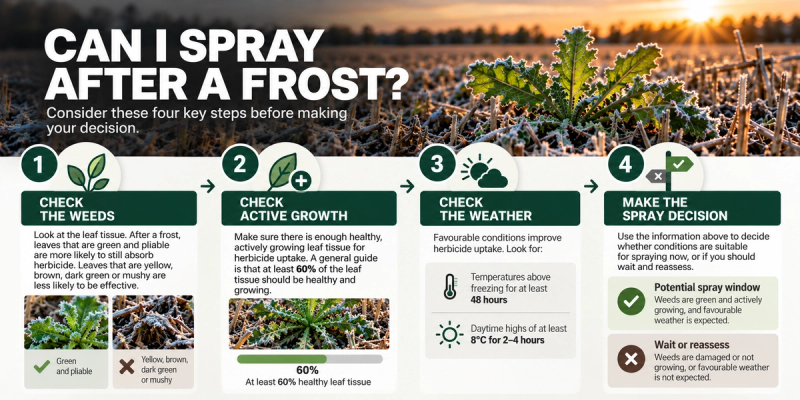
It depends on growing conditions. Killing frost for weeds is influenced by many different factors such as the plant species frost tolerance, weather prior to frost and growing conditions. A Canada thistle plant with little exposure to cooler temperatures may be susceptible to a frost of -3 to -4°C, whereas a plant that has gradually acclimatized to cooler conditions and progressively deeper frosts may survive a frost of -10°C or more. If weeds are green and leaf tissue is still relatively pliable after a frost, you may still have an opportunity to control perennial or winter annual weeds with glyphosate or another systemic herbicide. Control is possible on warm sunny days after a frost if at least 60 % of the leaf area is healthy. If most of the weed leaf area is dead (yellow, brown, or dark green in color or mushy texture), herbicide uptake will be minimal and performance will be poor. Generally, from most frost tolerant to least frost tolerant are dandelions, winter annuals, quackgrass, foxtail barley and Canada thistle. Avoid herbicide application if growing conditions are poor due to drought, flooding, heavy frost, or other stress factors.
Do herbicides work better after a frost?
Frost does not enhance the movement of sugar and herbicide to the roots of perennial weeds. However, it may not necessarily reduce control if enough healthy tissue remains to allow sufficient uptake of the herbicide.
How much frost is too much?
For glyphosate to be effective after a frost, weeds need at least 48 hours with nights above freezing and daytime highs of at least 8°C for 2-4 hours with active tissue growth. Early afternoon when temperatures are warmest is the best time to apply. Do not apply if a hard frost is expected shortly after application.
What weeds are you targeting for control?
Perennials
With the onset of lower temperatures and shortened days in the fall, perennial weeds start moving sugars to below-ground tissues to enhance winter survival. Spraying perennials in fall can take advantage of this downward flow.
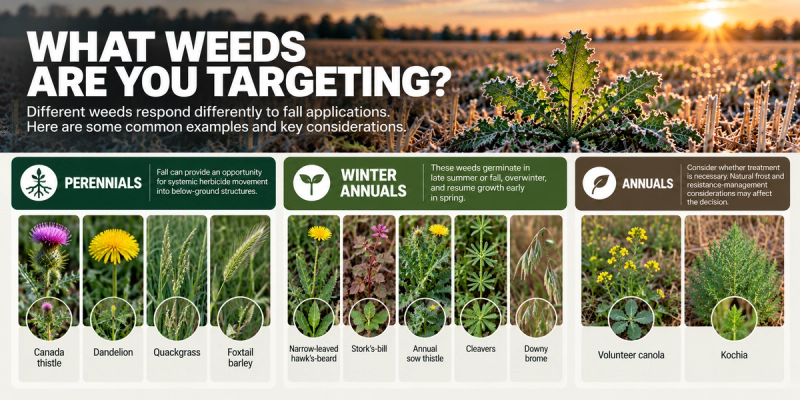
Common perennial weeds are Canada thistle, dandelion, quackgrass, and foxtail barley.
The best time to apply is from mid September to early October, before a killing frost. Perennials need time after harvest cutting to accumulate new leaf tissue to absorb herbicides. Weeds need to start actively growing again after harvest because herbicide uptake and translocation happen more-efficiently in actively growing weeds. Wait at least 10 days after harvest and until you see active growth. Remember that leaf surface area is still just a fraction of what it was prior to harvest, so post-harvest rates of glyphosate will need to be much higher (as much as 2-3 X higher) than the pre-harvest rate to get the same amount of herbicide into the root. Warmer temperatures and bright sunshine improve herbicide activity, so it is best to apply glyphosate and other systemic herbicides during the heat of day when perennial weeds are actively growing.
Winter annuals
Winter annuals germinate in late summer or fall, survive the winter, and start growing early in the spring before field work starts.
Common winter annual weeds are narrow-leaved hawk’s-beard, stork’s-bill, annual sow thistle (common and spiny), cleavers, and downy brome.
Best time to apply is early October until freeze up when winter annuals have emerged and are at the right stage for control. With the recent rains in many areas, winter annuals can hit those stages fairly quickly, so be prepared to move fast.
Annuals
Annual weeds can germinate year-round, including late summer or fall, and don’t usually survive the winter.
Common annual weeds are volunteer canola and kochia. For volunteer canola, leaving seeds undisturbed so they germinate or get eaten by birds or insects can help reduce populations for next year. For kochia, research out of southern Alberta suggests that kochia regrowing after a mid-August (or later) harvest will not produce seed before a killing frost in most years. Using glyphosate to control those annual weeds in fall may simply add selection pressure for the development of glyphosate resistance.
Best time to apply might be to let mother nature and a killing frost do the work for you.
What else should you consider?
Tillage
If you are planning tillage this fall, and growing conditions are good, allow a minimum of 3 days after application before tillage for the herbicide to translocate in the plant as much as possible. Under cool and cloudy conditions plant growth may slow down, so it is recommended to allow more time for translocation of the product to the roots of the weed (up to 10 days).
Water volumes
Since there is minimal canopy covering the target weeds, lower water volumes can be used but keep water volumes higher for severely damaged plants.
Does it make sense to add a tank mix partner with post-harvest glyphosate?
Yes. If you are targeting control of winter annuals or late flushing weeds that may set seed, adding a tank mix partner such as AMMO® EXTRA HERBICIDE, BATTLEFRONT® HERBICIDE, PILOT® HERBICIDE, or MPOWER® EXTRA HERBICIDE will improve control of tough to kill weeds such as dandelion, flixweed, narrow-leaved hawk’s-beard, stinkweed, volunteer canola, and more. Plus, it will get your cereal crops off to a cleaner start next year. If you are planning to grow canola or pulse crops next year your post-harvest herbicide options are more limited, call us at 1-844-269-3276 to discuss what options might be available.
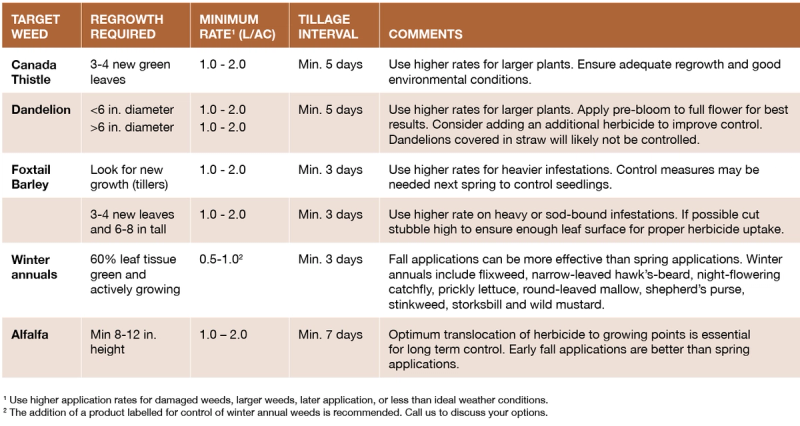
Recommended rates and staging for post-harvest application of glyphosate
The following are application and staging recommendations based on the weeds being targeted for a post-harvest application of DISRUPTOR® 540 GLYPHOSATE HERBICIDE:
Summary
If the window for pre-harvest application has closed. a post-harvest herbicide application for perennial and winter annual weeds can be a good strategy for cost effective perennial and winter annual weed control provided conditions are suitable. It is important to understand the benefits and risks before you apply. Need assistance? Call us at 1-844-269-3276.
AMMO®, BATTLEFRONT®, DISRUPTOR®, and PILOT® are trademarks of 1909 Crop Protection Solutions or its affiliates.
All other products mentioned are trademarks of their respective holders.