

How to Maximize the Performance of Your Post-Harvest Herbicide

2026-09-03
During harvest in Western Canada, it's always a good time to consider post-harvest herbicide application to manage hard to control winter annual and perennial weeds and clean up your cereal crop fields for next year.
Here are some tips to help achieve great post-harvest weed control:
Harvest management
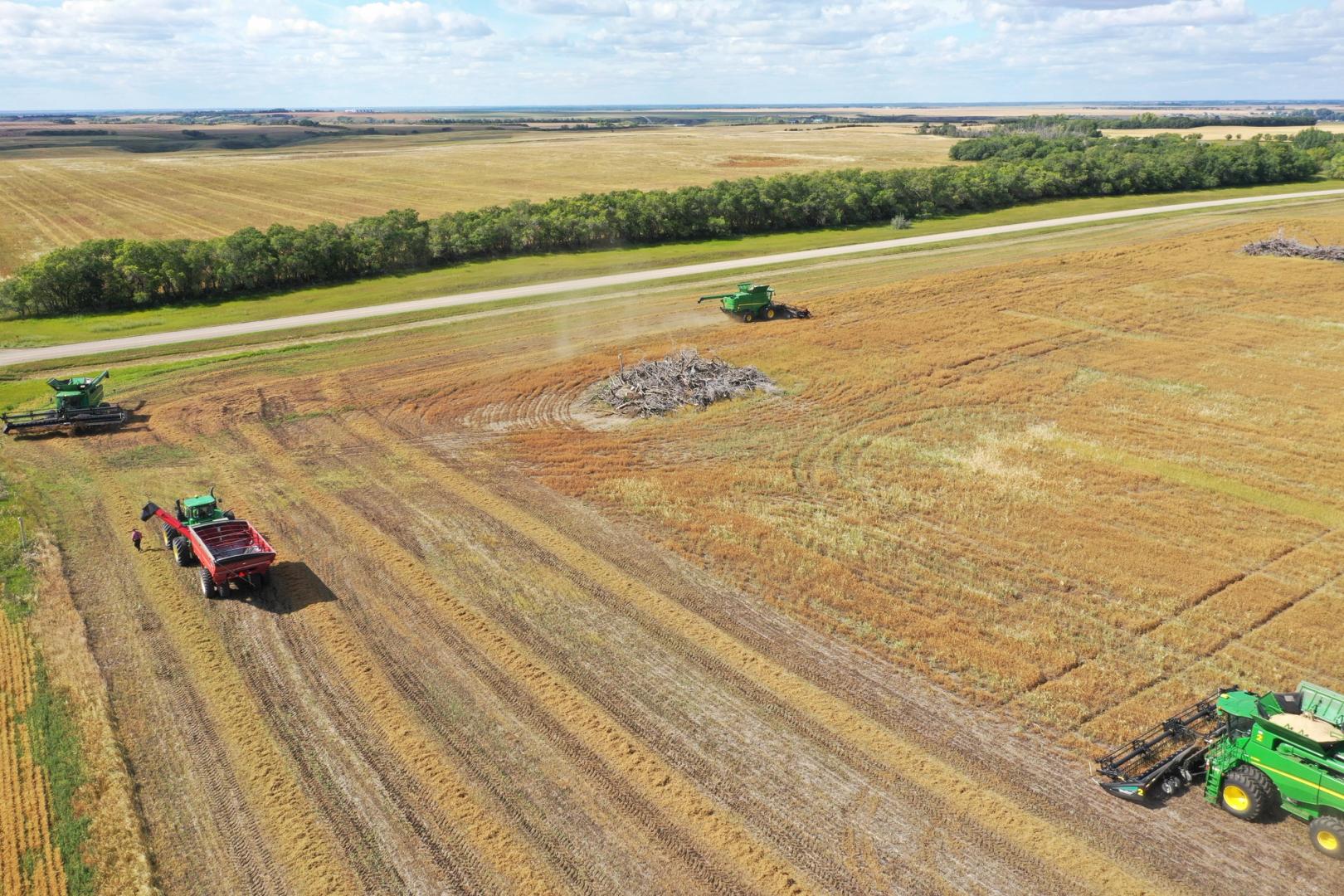
Consider cutting stubble high to maximize weed leaf area and to minimize the time it will take for plants to grow to the recommended stage. Also ensure straw and chaff are spread evenly so that proper coverage is obtained on low-growing and smaller weeds.
Ensure adequate regrowth
After harvest, spraying should be delayed until weeds grow back and develop new leaves. For effective control, any weed that is being sprayed post-harvest should be actively growing and have a minimum of 60% green leaf tissue.
Tillage interval
Under good growing conditions, allow a minimum of 3 days after application before tillage for the herbicide to translocate in the plant as much as possible. Under cool and cloudy conditions plant growth may slow down, so it is recommended to allow more time for translocation of the product to the roots of the weed (up to 10 days).
Water volume
Since there is minimal canopy covering the target weeds, lower water volumes may be used. Consider higher water volumes if there is thick weed regrowth, stubble or trash.
Tank mixing for winter annual weed control*
Perennial weeds are at lower risk of developing glyphosate resistance, therefore applying glyphosate alone at post-harvest can be an economical and effective way to control perennial weeds. When targeting heavy populations of winter annuals or late flushing annual weeds that may reach seed-set, consider adding a tank-mix partner like BATTLEFRONT® HERBICIDE, MPOWER® EXTRA HERBICIDE, AMMO® EXTRA HERBICIDE or PILOT® HERBICIDE. When selecting a tank-mix partner, verify the product’s label for registered crops and any re-cropping restrictions.
Spraying After A Frost
The impact of frost on weed control depends on the length and severity of the freezing temperatures, preceding weather, and the weed species. Generally, from most frost tolerant to least frost tolerant are dandelions, winter annuals, quackgrass, foxtail barley and Canada thistle. When possible, spray late in the morning or early afternoon when it’s warm and plants are most actively growing. Ideally, spray on sunny days. With cool temperatures, stop spraying 2 hours before sunset.

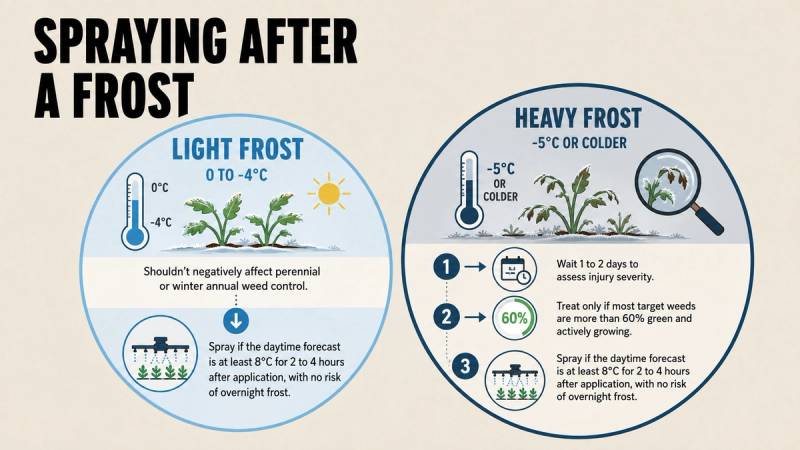
- Light Frost (0 to -4°C): shouldn’t negatively affect perennial or winter annual weed control. Spray if the daytime forecast is a minimum of 8°C for at least 2 to 4 hours after the application and there is no risk of overnight frost.
- Heavy Frost (-5°C or colder): wait 1 to 2 days to assess injury severity; treat only if the majority of target weeds are more than 60% green and show signs of active growth. Spray if the daytime forecast is a minimum of 8°C for at least 2 to 4 hours after the application and there is no risk of overnight frost.
What About Spraying Perennial Weeds After Harvest?
Cooler temperatures in the fall trigger the movement of nutrient reserves down to the root or storage structures of perennial plants to build up reserves for growth in the following season. A fall herbicide application takes advantage of this increased nutrient flow to the roots, increasing the amount of active ingredient that reaches the plants growing points. Keep in mind that with cooler temperatures comes slower growth and translocation, so perennial weed control may be reduced as compared to in-crop or pre-harvest herbicide applications depending on application conditions.
Recommended Rates and Staging for Post-Harvest Application of Glyphosate
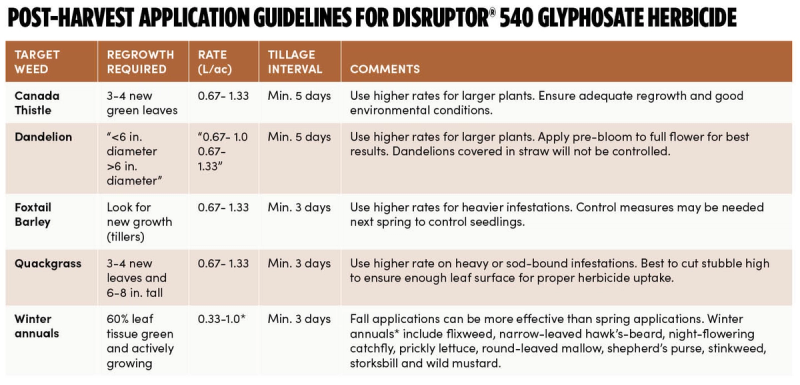
The following are application and staging recommendations based on the weeds being targeted for a post-harvest application of DISRUPTOR® 540 GLYPHOSATE:
What If Growing Conditions Are Not Suitable for Post-Harvest Application This Year?
If growing conditions are poor due to severe weather, a pre-seed application next spring may be required instead. 1909 has a full portfolio of pre-seed products for every crop and every acre on your farm, including:
AMMO HERBICIDE: Same active as Banvel® with proven control of kochia, cow cockle, smartweed and wild buckwheat.
AMMO EXTRA HERBICIDE: 1909 Exclusive Product that offers powerful, enhanced control of tough weeds like dandelion, narrow-leaved hawk’s-beard, and kochia.
AMMO C HERBICIDE: 1909 Exclusive Product with proven pre-seed control of kochia, redroot pigweed, stinkweed, and volunteer canola
BATTLEFRONT HERBICIDE: Same active as PrePass™ Flex with dependable pre-seed and post-harvest weed control of with some of the toughest weeds when mixed with DISRUPTOR® 540 GLYPHOSATE.
FURY™ HERBICIDE: Same active as Valtera® for pre-emergence weed control for use prior to seeding lentils.
FURY R HERBICIDE: 1909 Exclusive Product for pre-emergence weed control for use prior to seeding lentils.
HIMALAYA® EXTRA HERBICIDE: Same actives as Inferno® Duo for enhanced control of dandelion, narrow-leaved hawk’s-beard, flixweed, and stinkweed.
MPOWER EXTRA HERBICIDE: Same active as Express® for enhanced control of dandelion, narrow-leaved hawk’s-beard, flixweed, and stinkweed.
PILOT HERBICIDE: Same actives as Korrex™ with dependable reduced tillage control of some of the toughest weeds when mixed with DISRUPTOR® GLYPHOSATE.
REVENGE® HERBICIDE: Same active as Aim® with proven pre-seed control of kochia, redroot pigweed, stinkweed, and volunteer canola.
REVENGE B HERBICIDE: 1909 Exclusive Product with proven pre-seed control of kochia (including group 2, 4 and 9 resistant biotypes), volunteer canola, lamb’s quarters and redroot pigweed.
REVENGE PRO HERBICIDE: 1909 Exclusive Product containing 3 active ingredients (when mixed with glyphosate) for top-notch pre-seed control of flixweed, kochia, narrow-leaved hawk’s-beard, and stinkweed.
THRONE® II HERBICIDE: Same active as Authority™ with proven control of Kochia, redroot pigweed, lamb's quarters, wild buckwheat, common purslane and other tough to control broadleaf weeds.
THRONE III REVENGE HERBICIDE: Same actives as Authority Strike™ with proven control of kochia, redroot pigweed, lamb’s-quarters, wild buckwheat, volunteer canola, and other tough to kill broadleaf weeds.
Summary
A post-harvest herbicide application is a great strategy for cost effective, long-term perennial and winter annual weed control. So, when the window for pre-harvest application has passed, and winter annual and perennial weeds are in your fields, consider a post-harvest application for a head start in the spring.
AMMO®, BATTLEFRONT®, FURY™, HIMALAYA®, MPOWER® and PILOT®, REVENGE® and THRONE® are trademarks of 1909 or its affiliates.
